PHW trains and assesses plant and forklift operators on site, supplies H&S compliance document packs by sector or single hazard, and trains licensed premises staff on underage sales, drugs awareness and the Designated Premises Supervisor role. Every certificate PHW issues carries a QR code that opens a live, checkable record of who was assessed, on what, and when.

Pick the one that matches what you need, or use the nav above.

Assessed on your machines, on your site: telescopic handler and forklift categories, excavators, dumpers, rollers, MEWPs, lorry loader and slinger/signaller duties.
Machines →
Sector packs for construction, workplace transport, garages and workshops, and stone and silica fabrication, plus single-topic packs covering one hazard at a time.
Safety packs →
Underage sales prevention, drugs awareness in the licensed retail sector, and support for the Designated Premises Supervisor role.
Licensed →The same evidence structure across every machine category, so a site can check any operator the same way.
This evidence supports the employer's duty under PUWER 1998 regulation 9; it is not a substitute for it. The employer still decides whether an operator is authorised to use a particular machine on a particular site, and this training's job is to give that decision something solid to stand on.
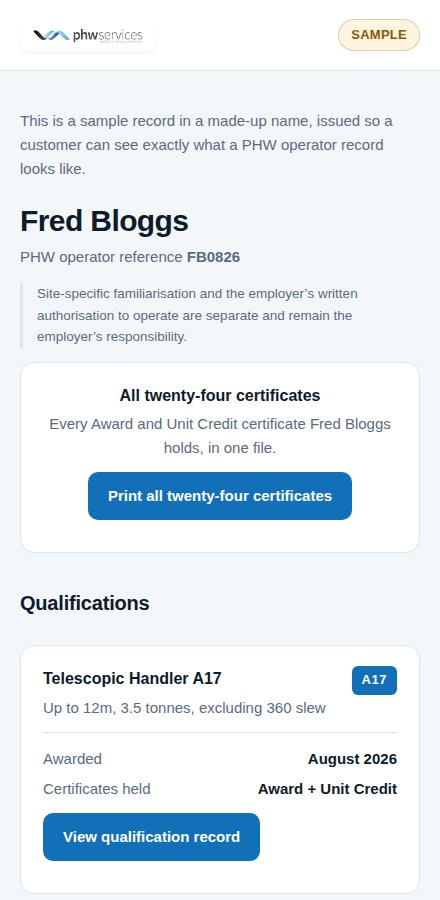
A live, working example so you can see exactly what an operator's evidence looks like before you book anyone.
A worked example covering certificates, theory and practical records, site evidence statements and QR codes. Marked SAMPLE throughout, so it can be shared freely before any real assessment is booked.
Open the sample operator packNo UK government body issues a licence to operate plant or a forklift, and no statute requires one. The duty to train and assess competence sits with the employer, under the Health and Safety at Work etc. Act 1974 section 2(2)(c) and PUWER 1998 regulation 9. This training gives the employer evidence to rely on; it does not by itself discharge that duty.
Read the full answers →The risks, the law and the right training and packs, by trade.

Site managers and principal contractors carry the duty for everyone working on their site, not just their own employees.
View →
Licensing officers and the courts want to see paperwork, not an opinion that staff know the rules.
View →
Cutting and grinding stone puts respirable crystalline silica into the air and vibration into operators' hands, and the slabs themselves are heavy enough to need mechanical handling.
View →
A haulage yard runs HGVs, forklifts, trailers and pedestrians through the same ground, often in the dark and against the clock.
View →
Forklifts, reach trucks and pedestrians pass through the same aisles all shift, racking holds loads well above head height, and stock moves by hand at every stage.
View →
A telescopic handler doing yard work, grain handling and trailer loading in the same day, on ground that is rarely flat, is the backbone of most farm operations.
View →
Forklifts moving stock, abrasive wheels cutting and grinding, and process chemicals in use on the same shop floor is a normal manufacturing shift.
View →
Excavators and telescopic handlers sorting and loading material, vehicles moving constantly through the yard, and the material itself often unknown until it is sorted, is what makes a waste site different from most others.
View →
Cutting discs, brake dust, solvents and vehicles up on a lift, sometimes all in the same bay, is a normal working day for a garage or workshop.
View →
When a machine goes out on hire, the duty to train and assess the operator sits with the hiring employer, not the hire company.
View →Tell us the machines, the pack or the venue, and the numbers, and we will come back with a price and dates.
Get a quote